| Citation: |
Dr. Praful Nandankar, Dr. Prashantkumar V. Dhawas. AI-Assisted performance evaluation and health monitoring of PEM fuel cells: an experimental study of component-level aging, LSTM-based degradation forecasting and random forest fault diagnosis[J]. Energy Lab, 2026, 4(1): 260105. doi: 10.54227/elab.20260105

|
AI-Assisted performance evaluation and health monitoring of PEM fuel cells: an experimental study of component-level aging, LSTM-based degradation forecasting and random forest fault diagnosis
-
Abstract
Proton-exchange-membrane fuel cells (PEMFCs) are at the core of clean hydrogen energy systems, but their long-term operation is constrained by coupled ageing of the membrane-electrode assembly and operational faults such as flooding, membrane drying, fuel starvation, and catalyst-layer degradation. This paper presents an experimental and data-driven study of PEMFC stack behaviour during
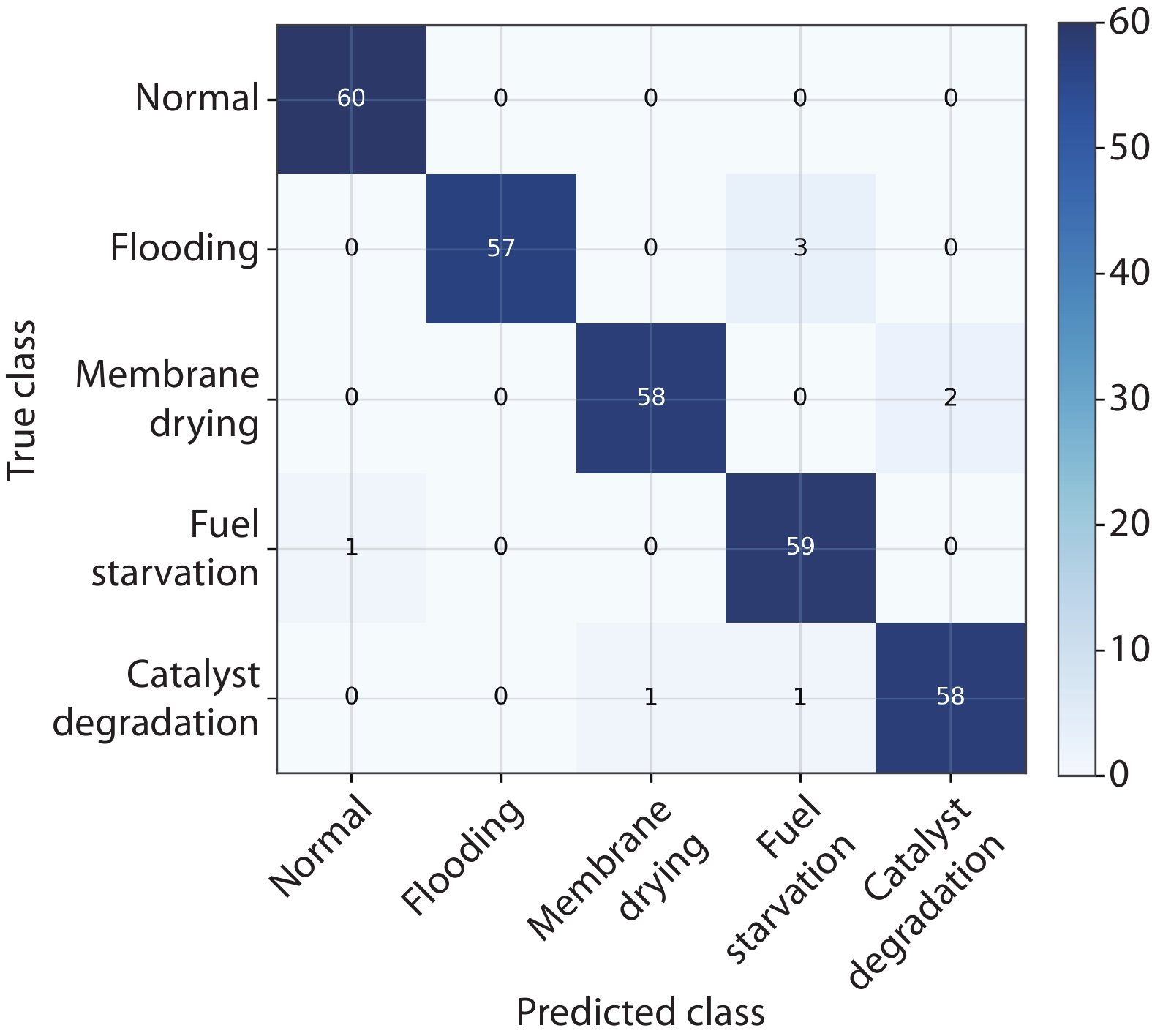
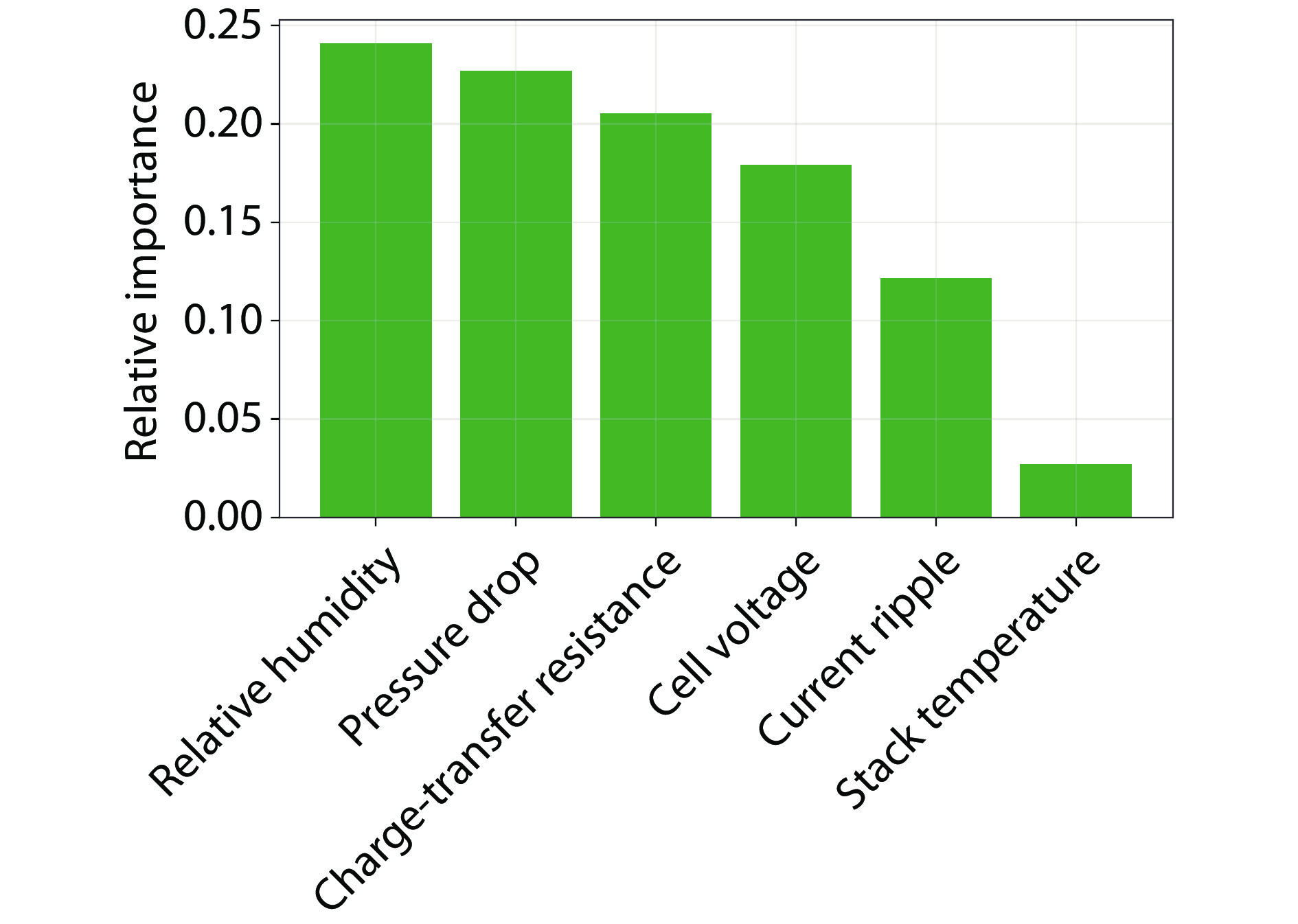
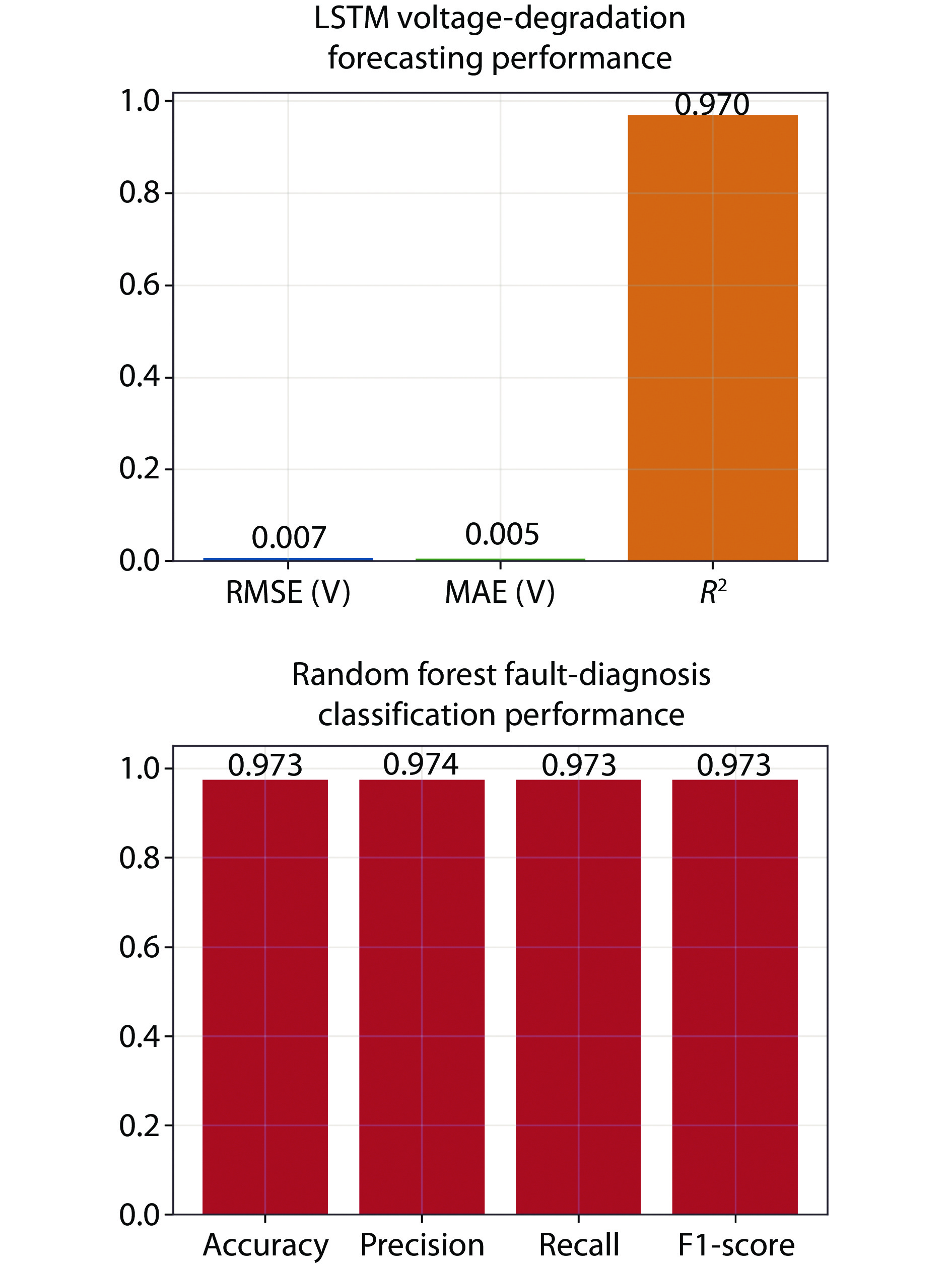
1500 hours of continuous operation using two complementary artificial-intelligence models: a Long Short-Term Memory (LSTM) network for voltage-degradation forecasting and remaining-useful-life (RUL) estimation, and a Random Forest (RF) classifier for fault diagnosis. Polarization and power-density characteristics were measured at 0 h, 500 h,1000 h and1500 h, while six operating parameters—cell voltage, stack temperature, relative humidity, pressure drop, current ripple and charge-transfer resistance—were recorded for fault-signature extraction. The revised analysis explicitly relates the observed stack-level degradation to the ageing pathways of the carbon paper, membrane, catalyst and ionomer and discusses their cumulative effects. A component-screening database was organized by mapping each key component and ageing mechanism to measurable sensor signatures and AI-learning variables; direct component-level chemical or microscopic measurements were not part of the present experiment and are therefore treated as a limitation rather than as synthetic data. The LSTM model predicted the voltage-degradation trajectory with RMSE of 6.85 mV, MAE of 4.51 mV and R2 of 0.970 and predicted RUL with R2 of 0.960. The RF classifier achieved 97.3% accuracy, 97.4% macro-precision, 97.3% macro-recall and 97.3% F1-score on five operating-condition classes. Results demonstrate that combining component-aware degradation interpretation with sequence-learning prognostics and ensemble fault classification provides a practical health-monitoring framework for PEMFC systems.-
Keywords:
- PEM fuel cell /
- component ageing /
- membrane /
- catalyst /
- carbon paper /
- ionomer /
- degradation forecasting /
- LSTM /
- remaining useful life /
- Random Forest /
- fault diagnosis /
- health monitoring /
- predictive maintenance
-

-
References
1. J. Larminie and A. Dicks, Fuel Cell Systems Explained, 2nd ed. , Wiley, USA, 2003. 2. Y. Wang, K. S. Chen, J. Mishler, S. C. Cho, X. C, Adroher, Appl. Energy, 2011, 88, 981 3. A. Nagila, S. Mg, F. D. Deepak, R. Kumar, P. V. Nandankar, Proc. Int. Conf. Edge Comput. Appl., 2022, 1, 711 4. Chandramma, P. Prakash, P. Nandankar, H. Roopa, I. Kathir and P. Singh, AIP Conf. Proc., 2023, 2690, 020047. 5. H. Xu, L. Wang, Z. Liu, G. Qiu, H. Zhou, H. Su, IEEE Trans. Transp. Electrif. , 2026, Early Access. 6. Z. Hua, Z. Zheng, E. Pahon, M. C. Marion-Péra. D. Hissel, Energy Convers. Manage., 2021, 231, 113825 7. Z. Zheng, R. Petrone, M. C. Pera, M. Hissel, C. Becherif, H. Pianese, N. Yousfi-Steiner, M. Sorrentino, Int. J. Hydrogen Energy, 2013, 38, 8914 8. R. Petrone, Z. Zheng, D. Hissel, M. C. Pera, C. Pianese, M. Sorrentino, M. Becherif, N. Yousfi-Steiner, Int. J. Hydrogen Energy, 2013, 38, 7077 9. K. Chen, S. Laghrouche, A. Djerdir, M. El Bagdouri, A. El Moudni, Int. J. Hydrogen Energy, 2019, 44, 1930 10. C. Zhang, S. Zhao, X. Yang, Y. Zhang, IEEE Trans. Energy Convers., 2021, 36, 41. 11. M. A. R. S. Khan, S. Al-Dahidi, Renew. Sustain. Energy Rev., 2022, 167, 112742 12. P. Archana, P. Divyabharathi, S. R. Balaji, N. Kumareshan, P. Veeramanikandan, S. T. Naitik, S. M. Rafi, P. V. Nandankar, G. Manikandan, Measurement: Sensors, 2022, 24, 100575 13. Y. Cheng, H. Zhang, L. Wang, J. Power Sources, 2021, 482, 228960. 14. B. Dwarakanath, G. Shrivastava, R. Bansal, P. Nandankar, V. Talukdar, M. A. Usmani, Int. J. Commun. Netw. Inf. Secur., 2023, 14, 342. 15. P. Nandankar, M. V. Aware, Proc. IEEE Int. Conf. Power Electron. , Drives Energy Syst. (PEDES), IEEE, India, 2012. 16. A. T. Jambhulkar, A. M. Bhoyar, C. M. Shivankar, P. S. Balwad and P. Nandankar, Int. J. Innovations Eng. Sci., 2023, 8, 1. 17. Q. Li, H. Wang, T. Wang, X. Li, Y. Liu, W. Chen, Z. You, IEEE Trans. Transp. Electrif., 2025, 11, 2707 -
Rights and permissions
This is an open access article under the terms of the Creative Commons Attribution License, which permits use, distribution and reproduction in any medium, provided the original work is properly cited.
Figures(6)
Tables(2)
Information
Article Metrics
Export File
Citation
Dr. Praful Nandankar, Dr. Prashantkumar V. Dhawas. AI-Assisted performance evaluation and health monitoring of PEM fuel cells: an experimental study of component-level aging, LSTM-based degradation forecasting and random forest fault diagnosis[J]. Energy Lab, 2026, 4(1): 260105. doi: 10.54227/elab.20260105
Format
Content
 DownLoad:
-
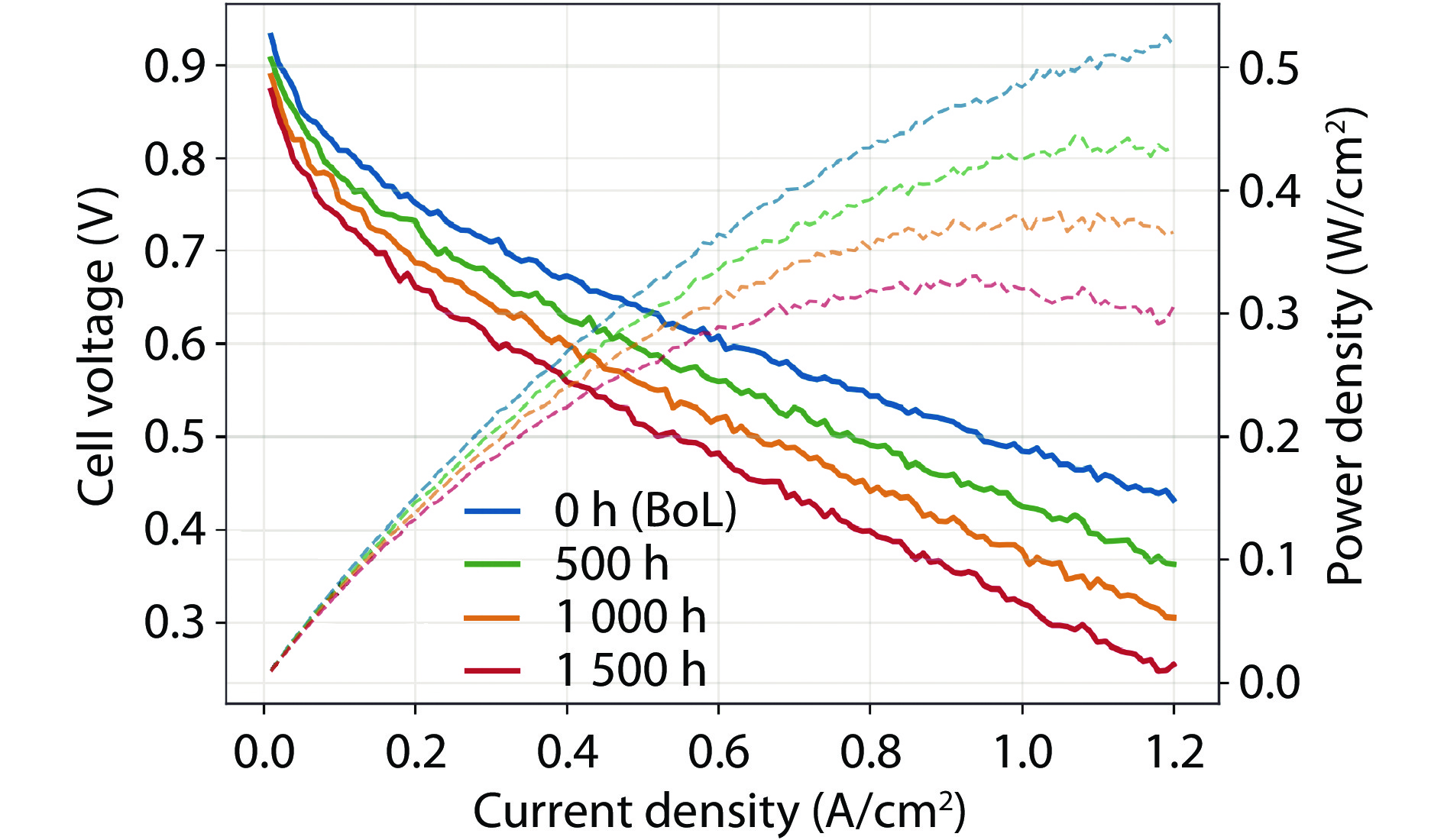
Figure 1.
Polarization and power-density curves at 0 h, 500 h,
1000 h and1500 h of operation -
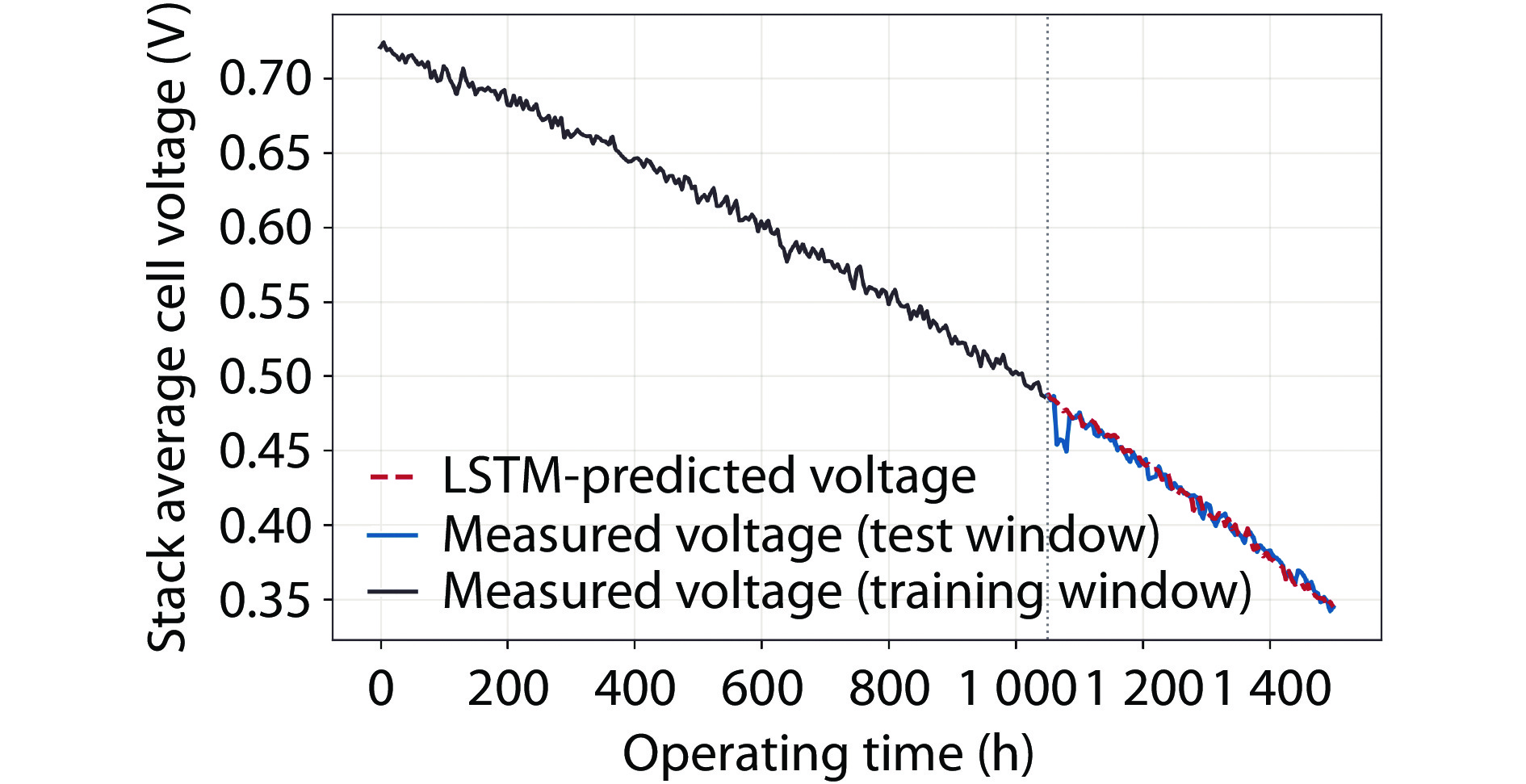
Figure 2.
LSTM-based voltage-degradation forecasting over the test horizon.
-
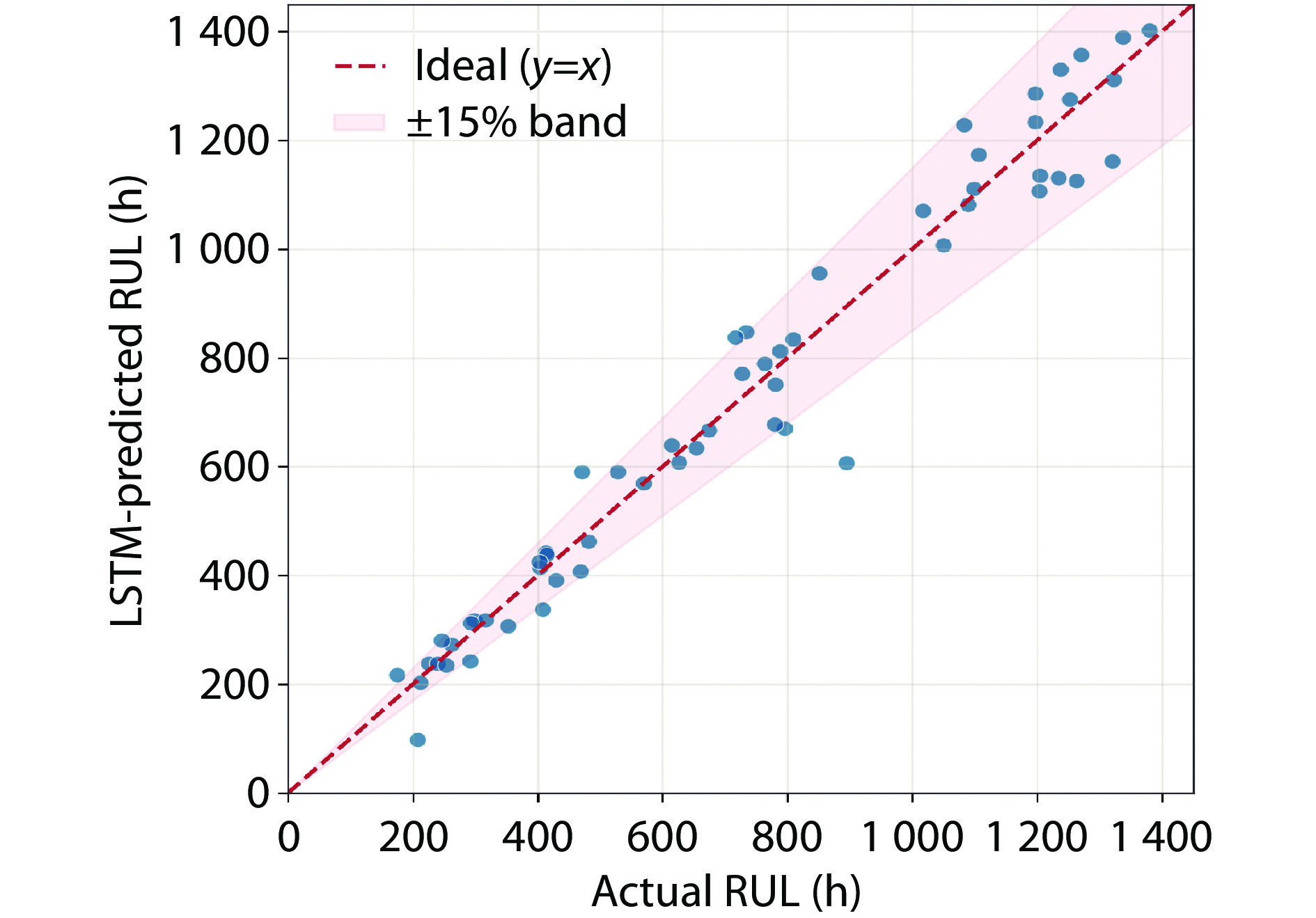
Figure 3.
Remaining-useful-life prediction parity plot (LSTM-based extrapolation to end-of-life voltage threshold)
-
Figure 4.
Confusion matrix for the Random Forest fault classifier on the held-out test set.
-
Figure 5.
Random Forest feature-importance ranking for fault diagnosis.
-
Figure 6.
Consolidated performance summary of the LSTM degradation-forecasting model and the Random Forest fault-diagnosis model.